Article: Chronograph: flyback, rattrapante: the different chronograph complications
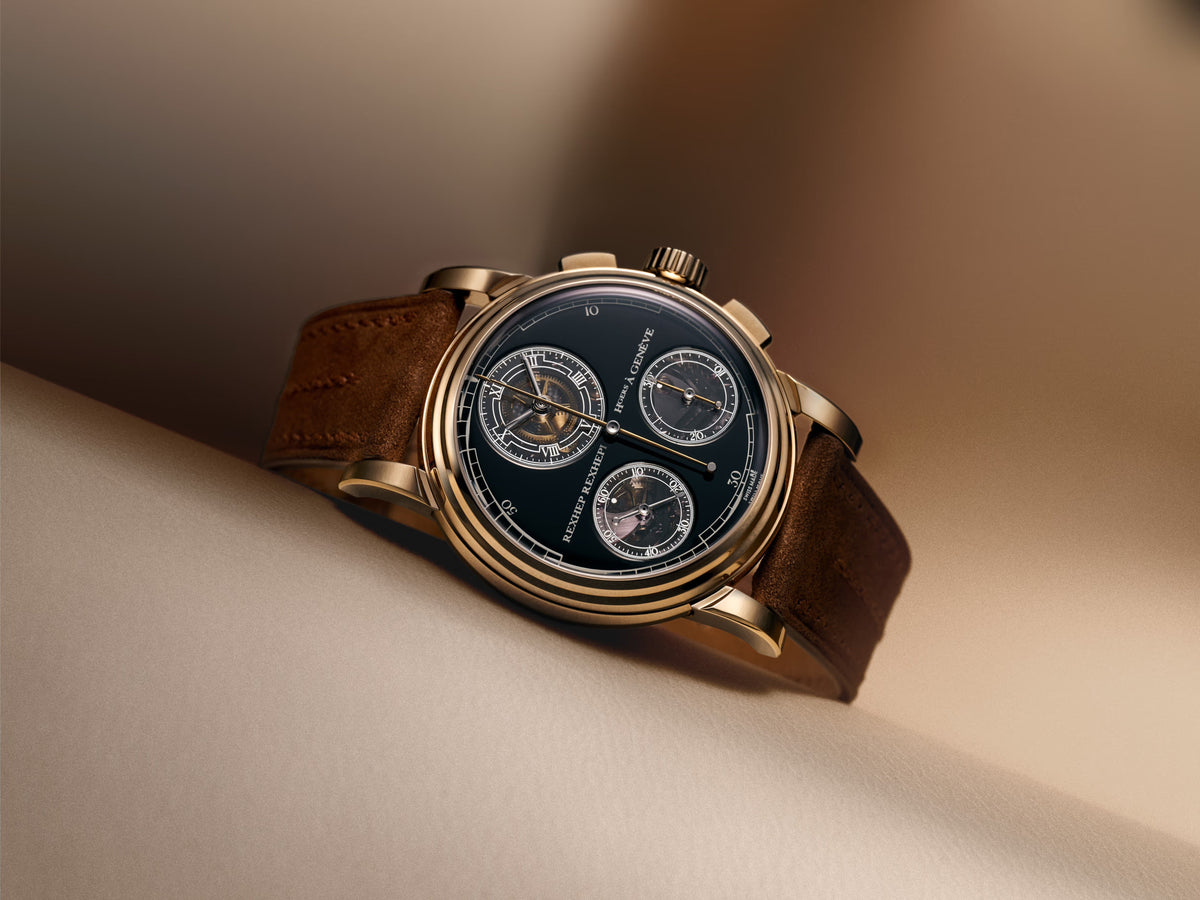
Chronograph: flyback, rattrapante: the different chronograph complications

The chronograph holds a special place in horological history. Unlike a classic watch, which tells the time, it can also measure a precise duration, independently of the time display. This function, familiar today, gave rise to a wide variety of mechanisms, developed to meet increasingly specific needs. From chronographs used in motor racing to aviation watches, and high-end horological pieces, this complication has evolved considerably. Behind these functions lie very different mechanical constructions: column-wheel, cam-operated, flyback, or split-seconds.
The classic chronograph: measuring a duration on demand
The principle of the chronograph is relatively simple. Pressing a pusher starts a dedicated timekeeping hand. Pressing it again stops it, allowing the elapsed time to be read, and then a final command resets it to zero.
On most mechanical chronographs, a central hand makes one revolution per minute. It allows the seconds to be read, while additional counters generally indicate the elapsed minutes and, depending on the model, the hours. Some chronographs also feature a tachymetric scale, which allows an average speed to be estimated over a given distance.
It is important to distinguish this hand from the classic seconds hand. On a three-hand chronograph, the seconds hand is used to read the current time. On many chronographs, the large central hand remains stationary when the chronograph function is not activated: it is only used to measure an interval of time.

The Rolex Daytona illustrates this use well. Appearing in 1963 under reference 6239, it combines the chronograph function with a tachymetric scale, particularly useful in the context of motor racing. The chronograph allows times to be measured, while the dial scale converts this measurement into an average speed indication.
On a mechanical chronograph, this function relies on a set of levers, wheels, and springs that allow the mechanism to start, stop, and reset. The difficulty lies in operating these operations without disrupting the normal functioning of the watch. It is precisely on this point that the different chronograph architectures are distinguished.
Column-wheel or cam: two ways to operate the chronograph
When looking at chronograph movements, two terms come up regularly: the column-wheel and the cam. They refer to two operating systems that organize the different phases of timing.
The column-wheel is a small toothed piece topped with vertical columns. When a pusher is operated, it rotates in increments and changes the position of the levers that operate the chronograph. Its role is to coordinate the different operations: start, stop, and reset. Its geometry allows the levers to move from one position to another in an organized manner.
This construction is often associated with traditional chronographs and haute horlogerie. It requires precise manufacturing and careful adjustment, but it does not guarantee in itself that one movement will be superior to another.
The cam system fulfills a similar function, but uses a profiled piece whose shape guides the levers. This solution can simplify certain manufacturing and assembly operations. It is notably present in chronographs designed to be produced on a larger scale. This does not mean, however, that a cam chronograph would necessarily be less reliable or less pleasant to use.


The quality of a movement depends on many parameters: overall design, component adjustment, lubrication, manufacturing quality, and maintenance. We must therefore remember an essential distinction: the column-wheel and the cam describe how the chronograph is operated, and not an additional timekeeping function. A column-wheel chronograph can be classic, flyback, or equipped with a split-seconds, depending on the construction chosen.
The flyback chronograph: restart without stopping
Flyback, sometimes called "return to flight", meets a very concrete need: measure several successive intervals of time without having to stop, reset, and then restart the chronograph each time.
On a classic chronograph, a new measurement normally requires three successive actions: stop the hand, reset it to zero, then restart the timing. With a flyback, a single press on the dedicated pusher instantly returns the hand to zero and restarts the measurement. The chronograph therefore does not need to be stopped beforehand.
This function makes full sense when measurements need to follow one another quickly. It was notably developed to meet the needs of air navigation, where pilots might have to time successive navigation sequences.


The mechanical peculiarity of the flyback is that the reset is carried out while the chronograph is running. The mechanism must therefore briefly interrupt the movement of the hand, return it to its initial position, and immediately resume its drive. This operation requires a suitable design to limit the stress on the components.
The flyback is not necessarily more accurate than a classic chronograph. Its advantage is above all functional: it allows measurements to follow one another more quickly. It must also be distinguished from the split-seconds. The flyback resets a hand to zero to start a new measurement; the split-seconds, on the other hand, allows an intermediate measurement to be kept while the timing continues.
The split-seconds: measure two times with a single chronograph
The split-seconds, also called a "split-seconds chronograph" in English, is one of the most complex variations of the mechanical chronograph. Its principle is based on two superimposed chronograph hands. At the start, they advance together and give the impression of forming only one. But an additional command allows one of the two hands to be stopped independently, while the other continues its course.
This function allows an intermediate time to be recorded without interrupting the ongoing measurement. A new press then releases the stopped hand, which instantly joins the other. It is this catching movement that gives the complication its name.
Let's take the example of a motor race. Two competitors start at the same time and cross a checkpoint a few seconds apart. The split-seconds allows the time of the first passage to be recorded while continuing to measure the time of the second.


The mechanical difficulty is significant. Two hands must be driven, one stopped without disturbing the other, then their movement synchronized again. The mechanism requires additional components, including control and retention organs for the stopped hand.
For more details on this wonderful complication, we invite you to read the excellent article by WatchProSite on the subject: Patek Philippe 5204P Split-Seconds Perpetual Calendar
The Patek Philippe reference 5370 also illustrates this complication in a contemporary interpretation of haute horlogerie. The split-seconds is therefore much more than an aesthetic variant: it allows a measurement that the classic chronograph cannot perform alone. In return, its construction is generally more complex, its adjustment more delicate, and its maintenance likely to require specific expertise.


One pusher, two or three pushers: a question of operation
The number of pushers constitutes another distinctive element of chronographs. It influences how the watch is used, but is not enough to determine the complexity of its movement.


As its name indicates, the single-pusher chronograph groups the chronograph controls on a single pusher, often integrated into the crown or placed as an extension of it. Successive presses allow the chronograph to start, stop, and then reset to zero, according to a sequence defined by the mechanism. This apparent simplicity imposes a precise organization of the controls: the system must know which operation to execute at each press.
The two-pusher chronograph separates the controls. One is generally used for starting and stopping, while the other operates the reset. This arrangement allows the chronograph to be restarted after a stop without necessarily resetting the hands to zero. It is today one of the most widespread configurations on mechanical chronographs.
A third pusher can be used to operate an additional function, notably on certain split-seconds chronographs or on more specific mechanisms. However, there is no universal rule stating that three pushers correspond to a specific complication. Their role depends on the construction of the movement.
The number of pushers must therefore be interpreted as an indication of the interface and available functions, rather than as a direct measure of horological sophistication.
The jumping minute counter: a different reading of time
On many chronographs, the minute counter advances gradually, in small fractions, at the pace of the central seconds hand. Other mechanisms use a jumping minute counter, whose hand advances one step when the full minute is reached.
This difference may seem minor, but it changes the reading of the timing. With a jumping display, the elapsed minute appears immediately, without the hand being between two graduations.
To achieve this result, the movement must accumulate and then release the energy necessary for the counter to advance. The difficulty lies in ensuring a clean and reliable jump, without disrupting the functioning of the chronograph or compromising the amplitude of the balance wheel.
This construction is not essential for measuring time, but it testifies to a particular search in the way of displaying information. It should be distinguished from a split-seconds or flyback chronograph: it is a variation of the display, and not a new way of triggering or restarting the timing.
From the historic chronograph to the collector's chronograph
The history of the chronograph is closely linked to the evolution of the uses of time measurement. In the 19th century, the progress of chronometry and precision instruments accompanied the development of pocket chronographs. With the appearance of wrist chronographs, the function becomes easier to use on a daily basis.
Throughout the 20th century, the needs of pilots, athletes, and professionals contributed to the evolution of the mechanisms. Aviation notably favored the interest in flyback, while motor racing contributed to popularizing chronographs equipped with tachymetric scales.
The Rolex Daytona has become one of the best-known examples of this relationship between chronograph and motor racing. But the historical interest of this complication is not limited to a single manufacture: many houses developed their own movements, with different architectures and functions.
The arrival of quartz in the 1970s profoundly transformed the watch industry and time measurement. Yet, mechanical chronographs kept their place, notably thanks to the interest they arouse with their construction, their functioning, and the technical solutions they bring together.
Today, manufactures continue to explore this complication. Some seek to improve the efficiency of the mechanism or to simplify its use, while others develop ever more elaborate functions. For the collector, these evolutions offer several entry points: a vintage Daytona can appeal through its sporting history and design; a single-pusher chronograph through its simplicity of operation; a split-seconds through the complexity of its mechanism.
Conclusion
The chronograph is a complication whose principle seems simple, but whose possibilities have developed considerably over time. The classic model measures a duration; the flyback facilitates the succession of measurements; the split-seconds allows an intermediate time to be recorded without interrupting the timing. The column-wheel, the cam, and the number of pushers describe, for their part, different ways of designing and operating the mechanism.
These distinctions allow us to better understand what we observe on a dial, but also what is happening inside the movement. They above all remind us that two watches that look alike can respond to very different mechanical logics.
This is also what makes chronographs interesting to collect. Behind a common function lie decades of research, sometimes very specific uses, and technical solutions that continue to bear witness to the ingenuity of watchmakers.


Leave a comment
This site is protected by hCaptcha and the hCaptcha Privacy Policy and Terms of Service apply.