The different types of movements in watchmaking
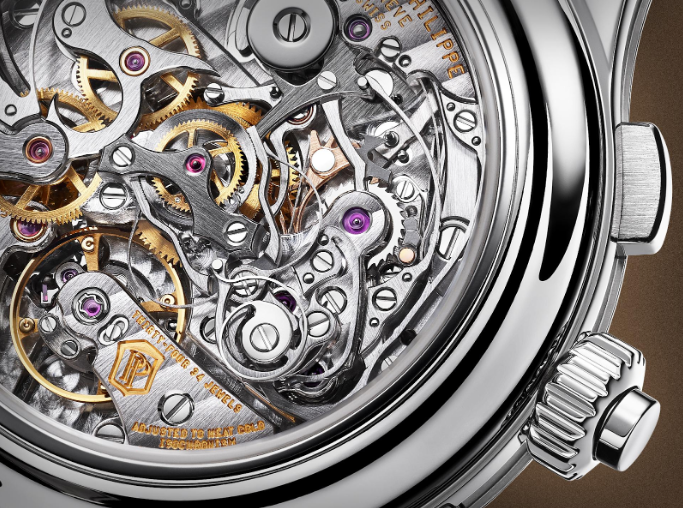
 Patek Philippe Calibre CHR 29-535 PS movement
When you first become interested in watches, it's easy to feel lost in the sheer volume of technical information. After being drawn in by the design of a dial or some other aesthetic aspect, a crucial question arises: how does a watch work?


The movement is what powers the watch, measuring time and driving its various functions, known as "complications." Complications can display the date, the different phases of the moon, or even chime the hours using mechanical parts on demand. There are several types of watch movements, each with its own specific characteristics, advantages, and disadvantages.


1. Mechanical movements
Mechanical movements are among the oldest and most respected in watchmaking. They are divided into two main categories: manual winding movements and automatic movements.
Manual winding movements:
Their principle is simple: by turning the watch's crown, you store energy in a mainspring barrel (red) using a balance spring. As it unwinds, the spring transmits the stored energy via a set of gears called the "gear train," to a set of parts called the "escapement" (blue). Time is then regulated by the balance wheel and hairspring, a regulating organ that oscillates at a specific angle to provide the balanced rhythm of the seconds (pink).
The escapement releases energy in small, regular amounts, thus regulating the rhythm of the movement. The "tick-tock" sound that can be heard if you listen closely is the effect of the pallets (red) against the teeth of the wheel (green).
A well-maintained movement can last for decades, and spare parts are often readily available. Furthermore, winding one's watch daily creates a special bond between the owner and their timepiece. It's said that it "brings life" to the watch.
Automatic movements: To avoid the need to wind their watches manually every day, ingenious watchmakers found a way to use the natural movement of the wrist to power the watch. Abraham-Louis Perrelet invented the first automatic movement in 1770, followed by Abraham-Louis Breguet, who perfected it. This system works thanks to an oscillating weight, a semi-circular rotor attached to the movement. When you move your wrist, the rotor spins and converts kinetic energy into mechanical energy, which is then stored in the mainspring barrel.

2. Electronic (quartz) movements
Quartz movements, introduced in the 1960s, revolutionized the watchmaking industry. Their operation relies on a quartz crystal and its piezoelectric properties. A battery powers this crystal, which vibrates at a frequency of 32,768 Hz. These vibrations are converted into electrical pulses, which are interpreted by an integrated circuit to measure time. A stepper motor then moves the hands on the dial.
Quartz movements offer exceptional precision, far superior to mechanical movements. They are also less expensive to produce and maintain, as they have fewer moving parts, which improves reliability. However, some enthusiasts miss the smooth sweep of the seconds hand characteristic of mechanical watches and the need for regular battery replacement. The fact that electronics are involved in the power transmission process also deters some enthusiasts, who consider it not to be "pure" mechanics.


3. So-called "hybrid" movements
More recently, hybrid movements have emerged, combining mechanical and electronic technologies. They aim to combine the precision of quartz with the allure of mechanics. A notable example is Seiko's Spring Drive, which uses a mechanical spring for power but regulates the movement with an electronic oscillator.
The result is quite spectacular, since the second hand "glides" on the dial, unlike quartz movements which cause the movement of the seconds hand to jerk.
In conclusion, each type of movement has its own characteristics and appeals to different types of watch enthusiasts depending on its advantages. Whether it's the tradition and craftsmanship of mechanical movements, the precision and accessibility of quartz watches, or the innovation of hybrid movements, there's bound to be a movement that suits you.
In all cases, the watches we sell are systematically checked, tested, and serviced as needed. Indeed, especially in the pre-owned watch market, it's essential to verify a watch's condition, which often reveals its history before being resold. Whether it's re-oiling, replacing a worn gasket, or a full service with parts replacement if necessary, we are committed to providing you with watches in the best possible condition.

Leave a comment
This site is protected by hCaptcha and the hCaptcha Privacy Policy and Terms of Service apply.